- Manufacturing
- Commercial
- ResidentialResidentialHomeowners need reliable modern solutions that can provide security, durability and accommodate their personal aesthetics.
- Awning Windows
- Sliding Windows
- Louvre Windows
- Bifold Windows
- Fixed Windows
- Stacker Windows
- Stacker Doors
- Bifold Doors
- Sliding Doors
- Pivot Doors
- Hinged Doors
- About
AboutFounded and headquartered in Sydney, A-Tech Australia is one of the market leaders for innovative aluminium solutions. We are a global player in the industry and are continuously thriving for new material solutions and apprising our partners worldwide of the versatility and presentation of our windows, doors and facades.- Contact
- Careers
- Blog



10 Jun 2026
If your home feels uncomfortably hot, even with the air conditioning running, you’re not alone. Many homeowners assume the issue lies with their cooling system, but in reality, the problem often starts with something less obvious: their windows.
Orientation is how a building or a home is positioned in relation to the sun’s paths in different seasons, as well as to prevailing wind patterns. In passive design, it is also about how living and sleeping areas are designed and positioned, either to take advantage of the sun and wind, or be protected from their effects.
The way your apartment or home is positioned, combined with the type of glazing used, plays a major role in how much heat enters your space. When these elements aren’t properly considered, the result is overheating, higher energy bills, and reduced comfort.
Why your home heats up faster than it should
One of the biggest contributors to indoor heat is solar heat gain, the amount of heat that enters your home through glass.
Windows exposed to direct sunlight for long periods, particularly in the afternoon, allow significant heat to build up indoors. Without the right glazing or shading strategy, this heat becomes trapped, making your home harder to cool.
- Gaining hot air and losing cool air: the amount of solar heat entering through your windows. Standard glass allows a significant portion of the sun’s heat to pass indoors, making rooms warmer and increasing the demand on cooling systems. Solar control glass helps reduce this heat transfer, keeping interiors more comfortable and energy-efficient without sacrificing natural daylight.
- Heat coming in via your windows: do you feel the radiant summer heat coming in despite having your blinds and shading in place? Glass is an excellent conductor of heat, and if your windows are single-glazed, heat will be radiating into your home. This can make it hot and uncomfortable.
- Heat pushing down from the roof space: standard glass allows sunlight to swiftly increase interior temperatures and produce uncomfortable hot spots next to windows. It can be challenging to keep a constant interior temperature throughout the day due to this heat buildup, which also puts extra demand on air conditioning systems.
- Heat rising up from below: glazing is frequently one of a home’s biggest sources of solar heat gain. Indoor temperatures can rise rapidly when direct sunlight passes through regular glass, particularly in spaces with plenty of windows or glazing. Solar control glazing increases energy efficiency and improves indoor comfort by lowering the amount of solar heat that passes through the window.
Orientation matters more than you think
West-facing windows receive intense afternoon sun and are the biggest cause of overheating. North-facing windows (in Australia) are exposed to consistent sunlight throughout the day. South- and east-facing windows receive less direct sunlight, often resulting in cooler but darker spaces.
The orientation of your home plays a major role in determining how much solar heat enters through its windows and doors. While the building’s position cannot be changed, the impact of solar exposure can be managed with the right glazing solutions.
Homes with large east- or west-facing windows may benefit from higher-performance solar control glass to reduce heat gain, while north-facing glazing can be optimised to balance natural light, comfort, and energy efficiency. Choosing glazing based on orientation helps create a more comfortable indoor environment without compromising views or daylight.
- Climate: some climates need mainly passive heating, some need passive cooling, and most need a combination of both. To understand your climate, you can first check your climate zone. This will give you a broad idea of your heating and cooling needs in each season.
- True north and sun angles: in Australia, the main solar access comes from the sun’s path in the north. All references to north in your home are to solar north, not magnetic north. True or solar north is not the same as magnetic north. Solar north can be significantly different from magnetic north, depending on where you live. To determine the appropriate orientation for your home, you will need to establish true or solar north for your location.
- Climate change: hotter summers with more extreme heat waves are becoming more frequent. Passive heating is still very desirable in most climate zones, but passive cooling is becoming more important. Additional attention to shading of windows and walls (particularly west facing) and exposure to cool breezes and other forms of natural cooling is needed.
Each direction requires a different approach to ensure the right balance between light, comfort, and energy efficiency.
Why glazing selection makes all the difference
Not all glazing is designed to perform the same way. The right glass selection can help regulate indoor temperatures, improve energy efficiency, and enhance year-round comfort by controlling how much solar heat enters the home.
For areas with high sun exposure:
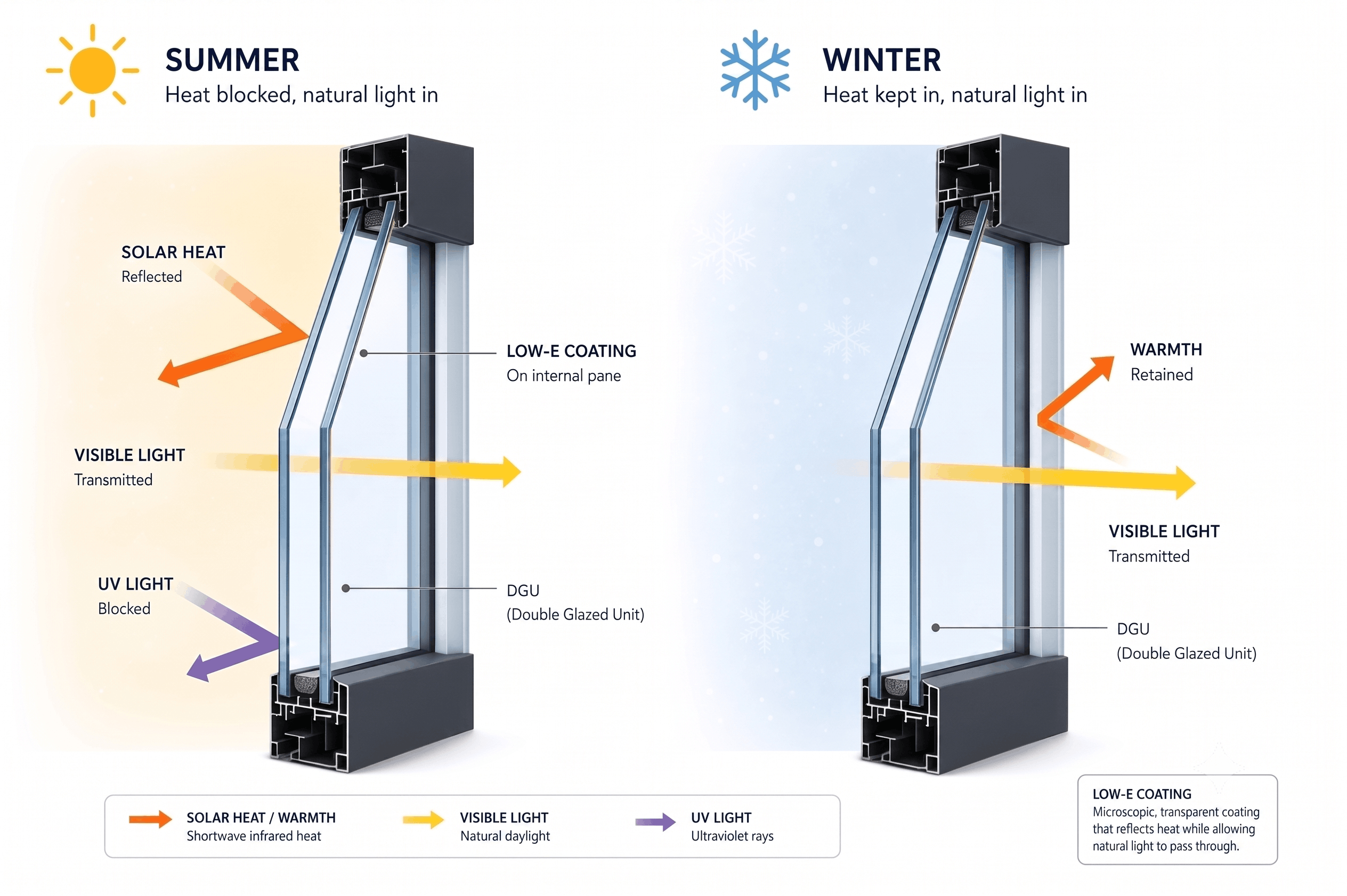
- Low-E glass: features a microscopically thin coating that helps reflect heat while allowing natural light to pass through.
- Tinted glass: reduces solar heat gain and glare, making it ideal for windows exposed to intense afternoon or all-day sun.
- Solar control glass: designed to minimise heat transfer into the home, helping to reduce overheating and cooling costs during summer.
For areas with lower sun exposure:
- Higher solar gain glazing: allows more of the sun’s warmth to enter the home, helping improve comfort during cooler months.
- High visible light transmittance glass: maximises natural daylight while maintaining thermal performance.
Selecting glazing based on the orientation and solar exposure of each façade can help create a more comfortable home while improving energy efficiency throughout the year.
Why compliance doesn’t always mean comfort
BASIX (Building Sustainability Index) compliance is a critical requirement for residential developments in New South Wales, however, achieving compliance can present various challenges, from high implementation costs to regulatory complexities.
Many Australian homes are designed to meet BASIX requirements, but compliance doesn’t always translate to real-life comfort.
In practice, glazing choices are sometimes made to meet minimum standards rather than to optimise how the home performs day to day. This can result in spaces that technically pass regulations but still feel too hot or poorly balanced.
Addressing these challenges effectively requires strategic planning, innovative design choices, and professional guidance.
If your home feels too hot, your air conditioning may not be the issue. In many cases, it’s the result of how your windows interact with sunlight. There is lots to prepare prior to construction. First, you must calculate the ideal orientation of your home for the area in which you are building. After that, you must decide what rooms in your home must get more direct light and which ones need less light.
Orientation for heating and cooling is a very important aspect that should never be ignored. Whether you are going to build a new house or buy a property in Australia, you should always pay close attention to the orientation. If you make a smart choice, you will be able to benefit financially for a long period of time.
By understanding orientation and selecting the right glazing for each space, homeowners can create a more comfortable and energy-efficient home without relying on constant cooling. Send your plans or measurements to A-TECH for tailored recommendations, expert advice, and solutions designed to suit your project. Contact us now.
FAQs
- Why is my home still hot even when the air conditioning is on?
In many cases, the issue isn’t the air conditioning itself but the amount of heat entering through your windows. Poor glazing or excessive sun exposure, especially from west- and north-facing windows, can cause heat to build up indoors faster than your cooling system can handle. - What is solar heat gain?
Solar heat gain refers to the heat that enters a home through glass when exposed to sunlight. The higher the solar heat gain, the more heat builds up indoors, making spaces less comfortable and increasing the need for cooling. - What type of glass helps reduce heat inside the home?
Low-E (low emissivity) glass is designed to reduce heat transfer while still allowing natural light in. It’s particularly effective for windows exposed to direct sunlight, helping to minimise overheating and improve energy efficiency. - Does meeting BASIX requirements guarantee a comfortable home?
Not necessarily. While BASIX ensures a home meets minimum energy efficiency standards, it doesn’t always account for how the space will feel in everyday use. Factors like window orientation and glazing selection still play a key role in overall comfort.

Location
Australia
Copyright © 2026 A-Tech Australia
