- Manufacturing
- Commercial
- ResidentialResidentialHomeowners need reliable modern solutions that can provide security, durability and accommodate their personal aesthetics.
- Awning Windows
- Sliding Windows
- Louvre Windows
- Bifold Windows
- Fixed Windows
- Stacker Windows
- Stacker Doors
- Bifold Doors
- Sliding Doors
- Pivot Doors
- Hinged Doors
- About
AboutFounded and headquartered in Sydney, A-Tech Australia is one of the market leaders for innovative aluminium solutions. We are a global player in the industry and are continuously thriving for new material solutions and apprising our partners worldwide of the versatility and presentation of our windows, doors and facades.- Contact
- Careers
- Blog



29 Jun 2026
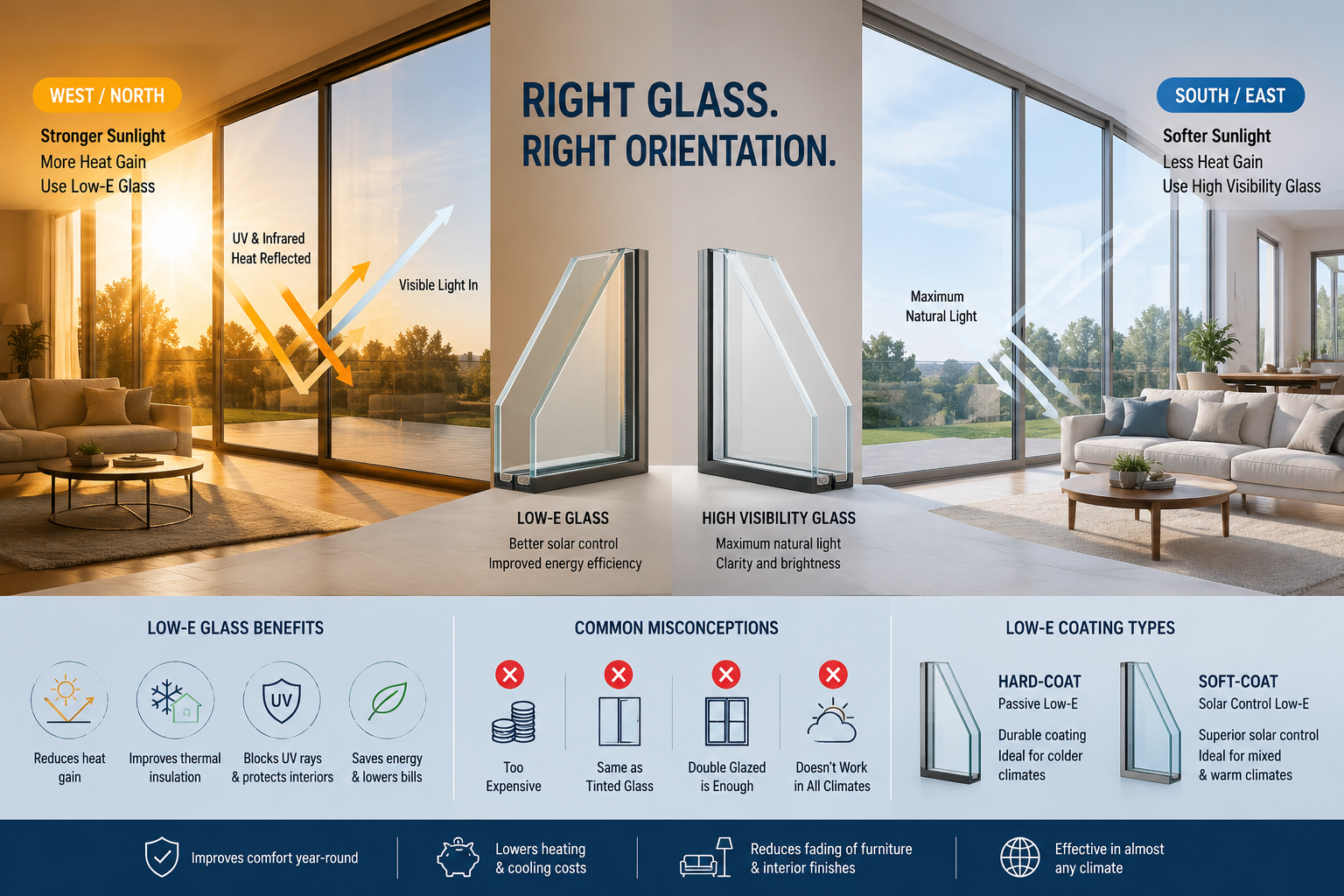
Low-E glass, short for Low-Emissivity or Low-Emittance, contains a microscopic coating that makes a window more thermally efficient. The coating is thin, non-toxic and virtually colourless. Low-E glass benefits are immense as it works to minimise the amount of ultraviolet and infrared light that can pass through the glass by reflecting it away.
Despite being a highly regarded innovation in the window industry, there remain a lot of Low-E glass misconceptions going around.
The U.S. Department of Energy estimates that 70 percent of energy loss occurs in windows and doors, and that 90 percent of window heat loss occurs through glass. Energy efficiency is important, but the lingo can be very confusing when researching different types of energy-efficient glass.
What is a Low-E window and what makes it energy efficient?
Low-E glass was created to minimise the amount of infrared and ultraviolet light that comes through your glass, without minimising the amount of light that enters your home.
Low-E glass windows have a microscopically thin coating that is transparent and reflects heat. The Low-E coatings keep the temperature in your home consistent by reflecting the interior temperatures back inside.
There are several factors used to measure the effectiveness of glass with Low-E coatings:
- Solar heat gain coefficient (SHGC): this is the fraction of incident solar radiation that is admitted through the window. This can be either directly transmitted and absorbed or radiated inward.
- U-value: this is the rating that is given to a window based on how much heat loss it allows.
- Visible light transmittance (VLT): The measure of how much visible light passes through the glass.
- Light to solar gain: The ratio between the window’s visible light transmittance and its solar gain coefficient rating.
Types of Low-E coatings
- Passive Low-E coatings (hard-coat): are manufactured using the pyrolytic process, which creates a pyrolytic coating. The coating is then applied to the glass ribbon while it is being produced on the float line, which causes the coating to “fuse” to the hot glass surface. This fusion creates a strong bond, or “hard-coat,” that is very durable.
- Solar control Low-E coatings (soft-coat): are manufactured using the magnetron sputtering vapour deposition (MSVD) process, which means the coating is applied off-line to pre-cut glass in a vacuum chamber at room temperature. This coating, which is also referred to as “soft-coat,” needs to be sealed in an insulated glass (IG) or laminated unit. The soft-coat has lower emissivity and superior solar control performance. This coating offers the highest performing solar control.
Which type of Low-E coating glass is best for my climate?
Before you decide, it is important to consider your area’s climate. If you live in a cold climate, the hard-coat Low-E glass may be an option for you, because it allows some of the sun’s short-wave infrared energy to pass through the glass. This helps to heat your home in the winter and allows the glass to reflect the interior long-wave heat energy back inside.
However, if you live in a mixed climate , the soft-coat Low-E glass is best, since it offers better UV protection and has a better overall U-value. The soft-coat Low-E coating also reflects the warm and cool air back into your room instead of allowing it to leak outside.
When you’re trying to decide which window style, size and design is best for your home, it’s also very important to consider which type of glass would work best.
Low-E coatings play an important role in the performance of your windows, can save you money on energy costs and can drastically reduce fading to furniture and décor by blocking UV rays.
When to use it (West/North)
In Australian residences with west and north-facing elevations, where solar exposure is greatest during the day, low-E glass is frequently most effective.
During the summer months, these places often receive more direct sunshine, which can raise indoor temperatures, cause glare, and increase the need for cooling.
The afternoon light is typically more powerful and challenging to manage on west-facing sides of the house. Living areas can be made more comfortable later in the day by using Low-E glass, which can help reduce solar heat gain while still allowing natural light into the space.
In Australia, windows facing north receive the most reliable sunlight.
Even though this orientation is ideal for daylight and natural warmth, overexposure to the sun without the proper glazing can cause overheating. Low-E glass may be able to balance better thermal performance with natural light in these situations.
High visibility glass is frequently more appropriate for locations where preserving the highest level of brightness and clarity is crucial.
Homeowners may favour glass that lets in more visible light without significantly lowering solar gain in areas with less sun exposure or softer natural light.
When not to use it (South/East)
Since sunlight is typically softer and less powerful in south and east-facing sections of a house, Low-E glass is not always required. Compared to spaces facing west or north, these orientations usually see less solar heat accumulation throughout the day, so excessive heat build-up is less of an issue.
Gentler morning sunshine from east-facing windows can assist naturally warm interior spaces early in the day without producing noticeable afternoon warmth. In order to maximise brightness and preserve a cleaner, more airy interior, homeowners frequently choose high visibility glass in these locations.
Because there is less direct sunshine in south-facing rooms, especially in the winter, they frequently feel darker. Interiors may appear colder or dimmer than planned if substantially solar-controlled glazing is used in these areas, significantly reducing apparent light.
It is frequently more sensible to prioritise visible light transmission over solar heat reduction in these lower-exposure situations. Instead of using the same glass specifications across the house, the proper glazing should complement the way the space feels and works.
Misconceptions about Low-E glass
- Low-E glass is way more expensive than regular glass: while many people assume Low-E glass comes at a significantly higher cost, the reality is that the Low-E coating is a one-time application added evenly across the glass surface. In many cases, the additional cost is only marginally higher than that of standard glass, while delivering long-term energy efficiency benefits.
- Low-E glass is the same as tinted glass: although both Low-E and tinted glass can help improve window performance, they are not the same. Tinted glass is created by adding alloy materials that alter the colour of the glass, which can result in visible colour variations across a project. Low-E glass, on the other hand, uses a virtually invisible coating designed to improve thermal performance while maintaining a more consistent appearance.
- Double-glazed windows by themselves are energy efficient enough: double-pane windows are certainly more effective than single glazing at reducing heat loss. However, modern window performance relies on more than just multiple panes. Advances such as improved spacers, gas-filled cavities, enhanced seals, triple glazing, and Low-E coatings all contribute to greater thermal efficiency and comfort.
- Low-E glass doesn’t work in all climates: Low-E glass can be used effectively across a wide range of climate conditions. Different Low-E coatings are designed for different performance requirements. For example, projects in warmer climates often benefit from glass with a lower Solar Heat Gain Coefficient (SHGC), which helps reduce unwanted heat entering the building and improves indoor comfort.
Projects in a cooler climate should install windows with a lower U-factor. U-factor numbers represent how well a window product prevents heat from escaping a home.
Low-E coatings can also be applied externally or internally, depending on your needs. Low-E coatings applied to exterior window panes prevent heat gains from exterior radiation, while coatings applied to interior windows help prevent heat loss. Manufacturers usually offer several types of Low-E coatings, so be sure to ask which is most suitable for your project.
Low-E windows help reflect heat and improve windows’ thermal performance, lower heating and cooling costs, allow natural light inside and work in almost any climate while being cost-effective, non-toxic and long-lasting.
If you want the best for your windows, Low-E glass windows are a perfect choice. However, not all Low-E windows are created equally, so purchase your windows from a trusted manufacturer.
Somewhere between 10-50% of all energy loss in a home happens through non-coated windows and doors, with numbers going even higher with tinted windows. Low-E windows, with their protective coating’s insulating nature and thermal properties, help homeowners spend less on heating and cooling costs.
Send your plans or measurements to A-Tech for tailored recommendations, expert advice, and solutions designed to suit your project. Contact us now.

Location
Australia
Copyright © 2026 A-Tech Australia
